Date Posted:
05/16/2006 10:09 AM
Posted By: matt_t

A huge mushroom cloud rises above Bikini atoll in the Marshall Islands July 25, 1946 following an atomic test blast, part of the U.S. military's "Operation Crossroads." The dark spots in foreground are ships that were placed near the blast site to test what an atom bomb would do to a fleet of warships. (AP Photo)


A massive column of water rises from the sea as the second atom bomb test at Bikini Atoll explodes underwater July 25, 1946. The blast and the enormous wave of water that followed immediately sank several abandoned ships - part of the site's dummy fleet of former warships. (AP Photo/Joint Task Force One

USS Saratoga (CV-3) sinking in Bikini Lagoon after she was fatally damaged by the "Baker Day" underwater atomic bomb test, 25 July 1946.
Note her hull number ("3") still visible at the front of her flight deck, air escaping from her submerged hull and oil streaming away to starboard.
Photograph from the Army Signal Corps Collection in the U.S. National Archives.


In this undated photo provided by the University of Alabama, UA biological science professor William Schroeder, shown here during an earlier mission off the west coast of Australia, is continuing his research related to how shipwrecks may be serving as artificial reefs in the Gulf of Mexico. Schroeder and other researchers have found coral growing at extreme depths in the Gulf of Mexico _ on several ships sunk during World War II by Nazi submarines. The research team spent more than two weeks off the coast looking at the war wreckage from U-boat attacks to see if deep-sea reefs are viable. Schroeder said humans have put artificial coral reefs in shallow water with good results, but not much is known how man-made structures fare in deeper waters. (AP Photo/University of Alabama via Tuscaloosa News)

University of Alabama professor Will Schroeder is shown examining coral in this undated photo in Australia released by the University of Alabama. Schroeder and other researchers have found coral growing at extreme depths in the Gulf of Mexico _ on several ships sunk during World War II by Nazi submarines. The research team spent more than two weeks off the coast looking at the war wreckage from U-boat attacks to see if deep-sea reefs are viable. Schroeder said humans have put artificial coral reefs in shallow water with good results, but not much is known how man-made structures fare in deeper waters. (AP Photo/University of Alabama)

The 105mm deck gun of the World War II submarine U-166 lies on the floor of the Gulf of Mexico in this still photograph taken from viedo made by an unmanned deep-sea vessel. The U-166 sank the American passenger freighter S.S. Robert E. Lee on July 30, 1942, and apparently was itself sunk minutes later by depth charges from a Coast Guard patrol boat. The U-166 was discovered during a gas pipeline survey, it was announced Friday June 8, 2001. (AP Photo/HO/C & C Technologies)

rman submarine U-352, which was sunk during World War II by the U.S. Coast Guard, lies on its side in 110 feet of water off Atlantic Beach, N.C., in this undated photo. (AP Photo/The Fayetteville Observer-Times, Cindy Burnham)

The coral reef of Isla de Aves is seen in this March 8, 1998 handout picture. The reef is a graveyard for ships of all ages; a well-preserved 17th century vase was salvaged off Venezuela's coast at the site of what is believed to be a major maritime disaster more than three centuries ago. Barry Clifford, of Cape Cod, Mass. and his team found two wrecks of ships they believe were part of a fleet of pirate ships and French warships that sank after hitting coral reefs. If, true, it would be only the second discovery of sunken pirate ships in the world. A ten-year-old wreck is seen at center. (AP Photo/Charles Brewer-Carias)

Rainbow Warrior is seen in this March 31, 2005 photo released by Greenpeace, in her final resting place 26 metres (28 yards) below the sea off the coast of Matauri Bay, Far North, New Zealand. The Rainbow Warrior has become an artificial reef and houses many species of marine life. This year marks the 20th anniversary of the bombing of the Rainbow Warrior in Auckland Harbour by the French Secret Service on the 10th July 1985. In July 1985 Rainbow Warrior, campaigning for a "Nuclear Free Pacific," was readying to sail to protest at France's South Pacific nuclear test site of Muroroa Atoll when two French mines ripped apart its hull. (AP Photo/Greenpeace, Miller, HO)

Two gag groupers lurk under a boxcar as a blue angelfish swims past in the waters of Boxcar Reef in the Gulf of Mexico off Florida's west coast. Advocates of artificial reefs say they bring more marine life to the relatively featureless Gulf bottom. (AP Photo/Ft. Myers News-Press, Steve Boutelle)
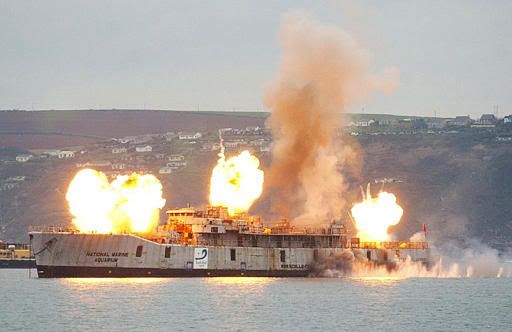
Former Royal Naval ship Scylla is sunk in Whitsand Bay, near Plymouth England Saturday March 27, 2004, sending it to the seabed to become what organisers said would be Europe's first artificial reef. (AP Photo/PA, Barry Batchelor)
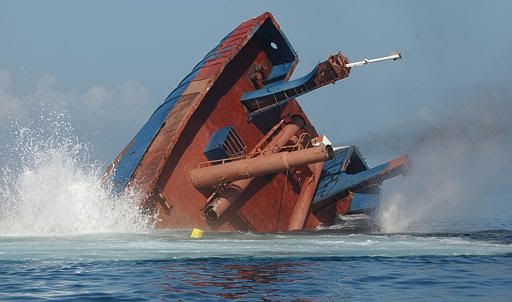
Water sprays as the bow rises into the air during the sinking of the Antilles Star, a 165-foot Dutch trawler, off the coast of Daytona Beach, Fla., on Tuesday, June 29, 2004. The ship was being sunk to form an artificial reef in the Atlantic Ocean off the Florida coast. About 100 new reefs are added to Florida's coastal waters each year. The state now has more than 2,000 artificial reefs, with 41 in Volusia County. (AP Photo/Orlando Sentinel, Stephen M. Dowell)
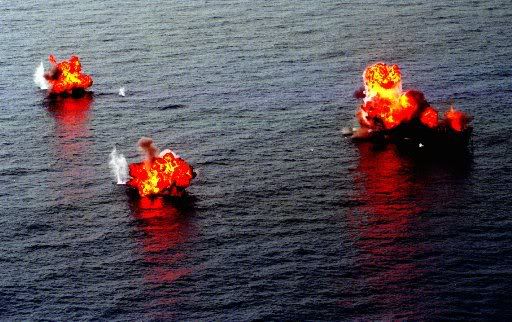
Fireballs erupt from three vessels as they are sunk in the Atlantic Ocean 10.5 miles east of Daytona Beach, Fla., Saturday, July 29, 1995 as part of an ongoing artificial reef program off Daytona Beach. A United States Navy explosive ordinance demolition (EOD) team from Mayport Naval base in Jacksonville, Fla., placed charges aboard three vessels all over 100 feet in length. The ships consisted of two ocean going tugs and the M/V Rio Luna, a 217-foot freighter that is the largest ship to be sunk since the artificial reef program began in 1985, bringing the total reefs created to 26.(AP Photo/Daytona Beach News-Journal, Brian Myrick)
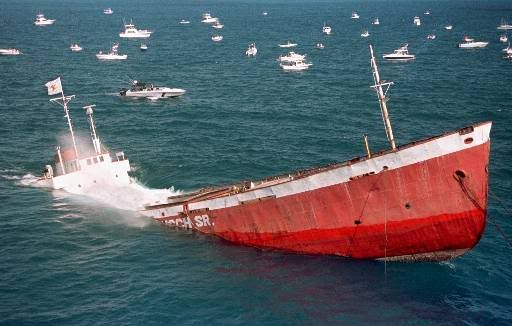
The Adolphus Busch Sr., a former island freighter renamed to memorialize the patriarch of the Busch brewing family, disappears beneath the ocean's surface Saturday, Dec. 5, 1998, about five miles southwest of Big Pine Key in the Florida Keys National Marine Sanctuary. The vessel was intentionally sunk to create an artificial reef to take pressure off natural coral reefs and create new marine habitats. (AP Photo/Andy Newman)
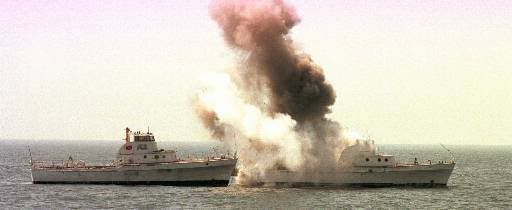
Smoke billows from one of two Coast Guard cutters during an explosion to blast holes in the haul of the ship during the sinking of the two cutters Friday, April 4, 1997. The ships were sent to the bottom eight miles offshore of Ocean City, Md., creating an artifical reef for fishing, diving and the attraction of marine life. (AP Photo/Salisbury Daily Times, Autumn Winterbottom)
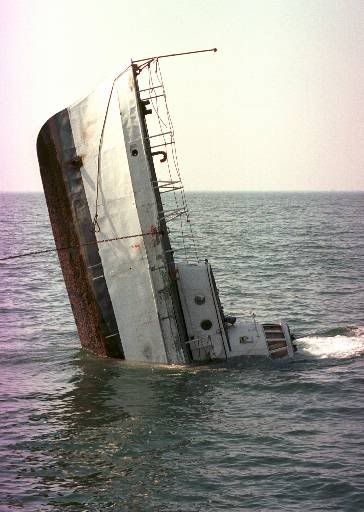
One of two coast guard cutters stands on end before the final plunge to the ocean floor Friday, April 4, 1997, eight miles offshore of Ocean City, Md., to create an artifical reef. (AP Photo/Salisbury Daily Times, Autumn Winterbottom)
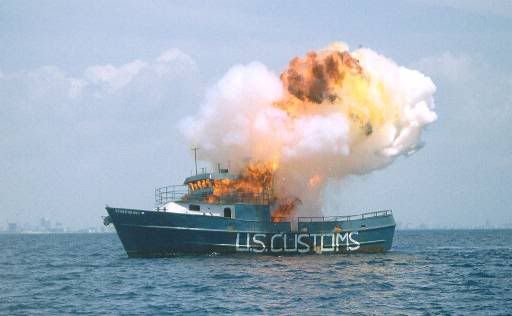
A cargo ship, formerly used to smuggle drugs into South Florida via the Miami River, is sunk by the U.S. Customs Service to create the "U.S. Customs Reef," Friday morning, July 13, 2001, four miles east of Key Biscayne, Fla. Three ships were sunk Friday to create the artificial reef for the benefit of fishermen, scuba divers and environmentalists, according to the U.S. Customs Service. (AP Photo/U.S. Customs Service)
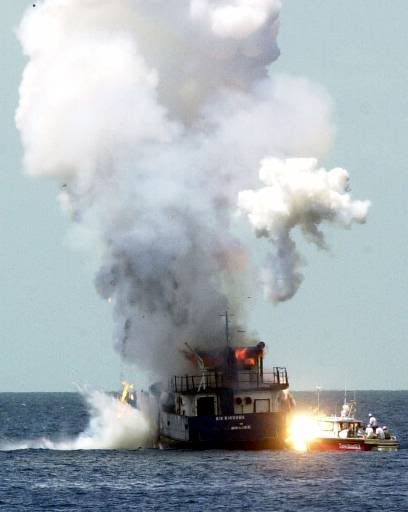
The Miguana, one of three drug freighters seized for smuggling that was sunk by the U.S. Customs off the coast of Miami, is destroyed Friday, July 13, 2001. The three freighters were sunk Friday to create an artificial reef in the Atlantic. (AP Photo/Marta Lavandier)
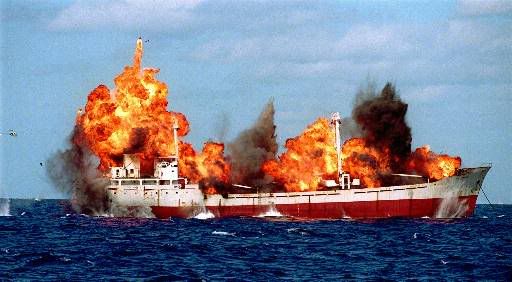
The 293-foot-long cargo ship Jed Carrier (cq) explodes Sunday Nov. 24, 1996 about 1 1/2 miles off Singer Island, Riviera Beach, Fla., in the Atlantic Ocean. The ship was sunk in 180 feet of water to become Ande Reef, a Palm Beach County artificial deep-water fishing reef. The flames are only for show, created by detonating gasoline cans on deck. The ship was sunk by Palm Beach County Environmental Resource Management; a U.S. Navy Explosives Ordinance Demolition Team from Mayport Naval Station provided the explosives expertise. (AP Photo/Lannis Waters, The Palm Beach Post)

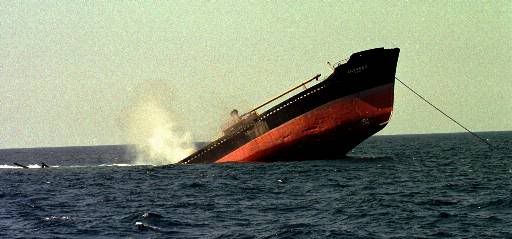
The freighter Antares heads to the bottom of the Gulf of Mexico on Sept. 27, 1995 in 120 feet of water 18 miles south of Pensacola, Fla., to become the largest artificial reef off Florida. The 387-foot-long Antares from Panama had been moored at Alabama State Docks in Mobile, Ala., for more then a year, since being towed in when its crew radioed that it was sinking. (AP Photo/Mobile Register, Kiichiro Sato)
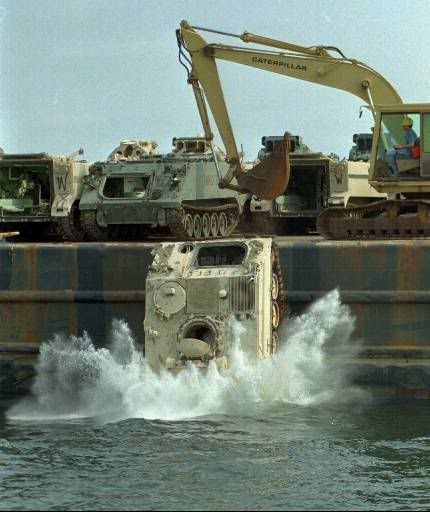
A U.S. Army M-901 anti-tank vehicle plunges into the Atlantic Ocean off the coast of Manasgaun, N.J., Friday, Aug. 16, 1996. The New Jersey National Guard pushed ten obsolete military vehicles to the ocean depths as part of "Reefex" an ongoing program that turned the vehicles into artifical reefs. The waters off Maryland and Virginia will each have 26 vehicles aboard the barge dropped on reef sites.(AP Photo/Daniel Hulshizer)
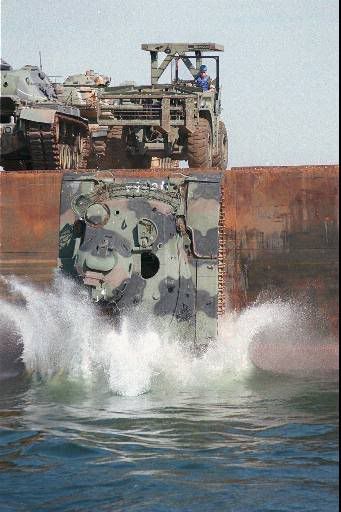
Members of the Army and Air National Guard along with Navy seabees dump a M60 tank into Atlantic Ocean to form an artificial reef Friday, Aug. 21, 1998, in Point Pleasant, N.J. (AP Photo/Asbury Park Press Photo, James J. Connolly Press)
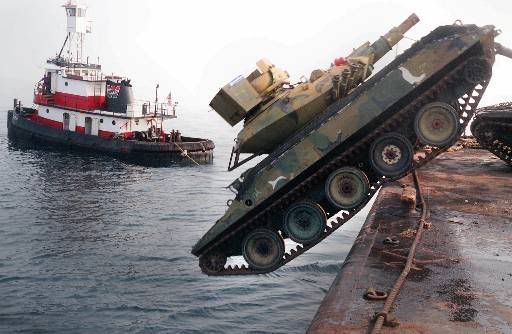
A U.S. Army M551 Sheridan tank is pushed off a barge into the Atlantic Ocean off the Virginia coast Sunday morning, Aug. 18, 1996. Eight M551 Sheridan Tanks, three armored personnel carriers and one missile launcher were dropped into the ocean to support the Virginia Marine Resources Commission Artificial Reef program. The vehicles were added to the Tower Reef, an artificial reef that provides habitats for fish, aiding in their reproduction. (AP Photo/The Virginian-Pilot, Candice C. Cusic)
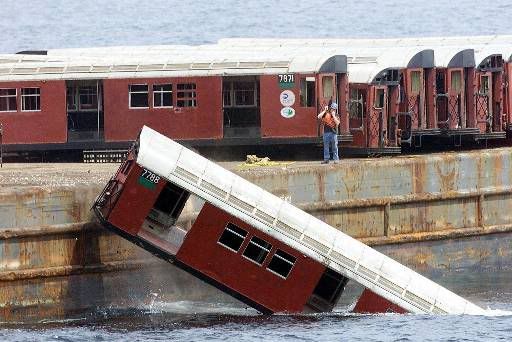
As a workman looks on, a New York City subway car disappear into the Atlantic Ocean after being pushed off a barge 19 miles east of Cape Henlopen, Del., Tuesday, Aug. 21, 2001. The Delaware Division of Fish and Wildlife sank 27 subway cars in 70-90 feet of water to form an artifical reef. (AP Photo/Roberto Borea)

Sam Bren, president of the Waikiki Neighborhood Board, sits on one of many toilets stored at The Environmental Group property Tuesday, July 9, 1996, in Honolulu. Bren is working with the company to get the Honolulu City Council to allow parts of the toilets to become artificial reefs. A law passed requiring efficient toilets will put about 100,000 toilets out of date, and a portion would head for the dump unless other uses can be found for them. (AP Photo/Tony Cheng)

The Canadian naval vessel Yukon sits at a dock with the mast of the 1864 Star of India behind it, Tuesday, July 11, 2000, at a harbor in San Diego, Calif. The Yukon, with holes cut in her hull, will be towed out to sea this weekend and sunk to become an artifical reef for fish and divers. (AP Photo/Bob Grieser)

Tugboats ease the decommissioned Navy Landing Ship Dock (LSD) Spiegel Grove from her "mothballs" mooring location at the James River Reserve Fleet Wednesday, June 13, 2001, as they begin to tow the 510-foot vessel to a Virginia-based shipyard. The vessel, which has not moved for more than 10 years, is to be cleansed in preparation for its sinking off the Florida Keys as an artificial reef for sport diving enthusiasts. (AP Photo/Andy Newman)

Supervisors for the Spiegel Grove artificial reef project walk to the 510-foot retired U.S. Navy vessel's gangway in Chesapeake, Va., Tuesday, April 9, 2002. After a thorough cleansing and environmental inspections by the Coast Guard and the Environmental Protection Agency the ship is destined to be sunk off Key Largo, Fla., in the Florida Keys National Marine Sanctuary. When submerged, the vessel will carry the accolade as largest ship in the world ever to be intentionally scuttled to create an artificial reef. (AP Photo/Andy Newman, Florida Keys News Bureau)

Volunteer workers drag pump hoses on the well deck of the U.S. Spiegel Grove, Thursday, May 16, 2002, in Key Largo, Fla. The decommisioned ship is slated set to be sunk as an artificial reef off the Florida Keys on Friday. (AP Photo/Florida Keys News Bureau, Andy Newman)

Rob Bleser, manager for the Spiegel Grove artificial reef project, marks a hatch on the 510-foot retired U.S. Navy ship to be welded shut Tuesday, April 9, 2002, Chesapeake, Va. After a thorough cleansing and environmental inspections by the Coast Guard and the Environmental Protection Agency the ship is destined to be sunk off Key Largo, Fla., in the Florida Keys National Marine Sanctuary. When submerged, the vessel will carry the accolade as largest ship in the world ever to be intentionally scuttledto create an artificial reef. (AP Photo/Florida Keys News Bureau, Andy Newman)

The retired U.S. Navy ship Spiegel Grove passes by downtown Norfolk, Va. Wednesday May 8, 2002, enroute to the Atlantic Ocean for a voyage to Key Largo, Fla., where it is to be sunk as an artificial reef in the Florida Keys National Marine Sanctuary. The decommissioned Landing Ship Dock is to be the largest ship in the world ever intentionally submerged to create an artificial reef. (AP Photo/Florida Keys News Bureau, Andy Newman)

The Spiegel Grove, a 510-foot landing ship dock decommissioned in 1989 after service in the Atlantic and Mediterranean, sits anchored Wednesday, May 15, 2002, near Key Largo, Fla. The ship is to be sunk by explosives Friday to create an artificial reef in in the Florida Keys National Marine Sanctuary. (AP Photo/Wilfredo Lee)

Todd Schauer, a salvage engineer with Resolve Marine Group, shows work done on the Spiegel Grove, a 510-foot Navy ship retired in 1989, in an attempt to roll and right the ship on the sea floor near Key Largo, Fla., Sunday, June 9, 2002. The ship was to be sunk to create an artificial reef in the Florida Keys National Marine Sanctuary when it went down prematurely May 17, landing upside down. (AP Photo/Wilfredo Lee)

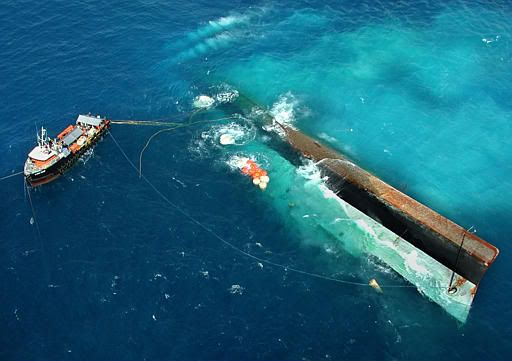
With the help of air lift bags, air injection in ballast tanks and pull from two tugboats, the Spiegel Grove begins to to rotate Monday, June 10, 2002, in the Florida Keys National Marine Sanctuary. The 510-foot retired Navy ship prematurely sunk and flipped May 17 about six miles off Key Largo, Fla. The process to reorient and fully sink the ship is being facilitated to make the Spiegel Grove the largest ship in the world to be scuttled to create an artificial reef. (AP Photo/Florida Keys News Bureau,Andy Newman)


The salvage boat Lana Rose is anchored near the upturned hull of the Spiegel Grove, Sunday, June 9, 2002, six miles off Key Largo in the Florida Keys National Marine Sanctuary. The Spiegel Grove, a 510-foot retired Navy ship, was scheduled to be sunk May 17 but rolled over with its bow sticking out of the water. Workers will attempt to right the ship and sink it. The effort is being facilitated to make the Spiegel Grove the largest ship in the world to be scuttled as an artificial reef. (AP Photo/Wilfredo Lee)

Divers explore the USS Spiegel Grove Friday, May 16, 2003 near Key Largo, Fla. The Spiegel Grove, a Landing Ship Dock (LSD 32) at 510 feet in length, 84 feet wide, was sunk last year and is the largest vessel ever intentionally sunk as an artificial reef. (AP Photo/Wilfredo Lee)

Divers explore a gun turret on the USS Spiegel Grove Friday, May 16, 2003 near Key Largo, Fla. The Spiegel Grove, a Landing Ship Dock (LSD 32) at 510 feet in length, 84 feet wide, was sunk last year and is the largest vessel ever intentionally sunk as an artificial reef. (AP Photo/Wilfredo Lee)
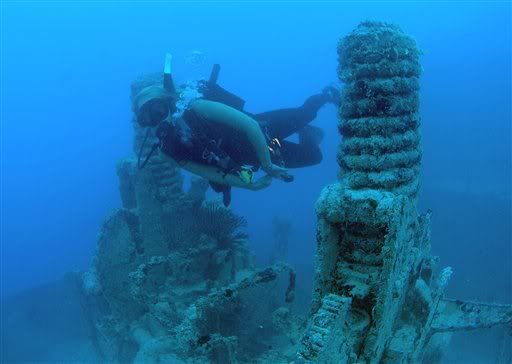
In this handout photo provided by the Florida Keys News Bureau, diver Reese Kennedy swims between coral-encrusted guns on the wreck of the Spiegel Grove, Tuesday, July 12, 2005, off Key Largo, Fla., in the Florida Keys National Marine Sanctuary. Since it was fully sunk on June 10, 2002, the decommissioned Navy Landing Ship Dock has rested on its starboard side. But Monday, July 11, 2005, divers discovered the ship _ serving as artificial reef on the bottom in 130 feet of water off Key Largo _ flipped upright as the core of Hurricane Dennis passed some 200 miles to the west. (AP Photo/Florida Keys News Bureau, Fraser Nivens)

In this handout photo provided by the Florida Keys News Bureau, divers swim on the shipwreck Spiegel Grove Tuesday, July 12, 2005, off Key Largo, Fla., in the Florida Keys National Marine Sanctuary. Since it was fully sunk on June 10, 2002, the decommissioned Navy Landing Ship Dock has rested on its starboard side. But Monday, July 11, 2005, divers discovered the ship _ serving as artificial reef on the bottom in 130 feet of water off Key Largo _ flipped upright as the core of Hurricane Dennis passed some 200 miles to the west. (AP Photo/Florida Keys News Bureau, Fraser Nivens)

Coral formations grow on the artificial reef project, Wednesday, Jan. 21, 2004, in Pemuteran, on the island of Bali, Indonesia. The project is part of a highly original and ambitious underwater experiment which uses low-voltage electrical stimuli to revive the badly damaged coral reef. (AP Photo/Wolf Hilbertz)
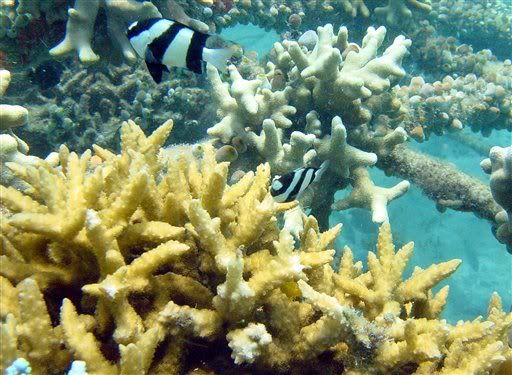

A scuba diver swims around the artificial reef project, Jan. 18, 2004, in Pemuteran, on the island of Bali, Indonesia. The cables are part of highly original and ambitious underwater experiment which uses low-voltage electrical stimuli to revive the badly damaged coral reef. (AP Photo/Wolf Wilbertz)

Divers install a buoy anchoring device over a geodetic marker on the sea floor in the Florida Keys National Marine Sanctuary, Thursday, June 17, 2004, off Key Largo, Fla. From left is Tim Keeney, left, deputy assistant secretary for the National Oceanic and Atmospheric Administration; Dan Bosta, director of National Marine Sanctuary Program; Jim Connaughton, a senior White House environmental advisor and Harold Hudson, a Keys Sanctuary biologist. The geodetic marker is the first of its kind under thesea, according to officials, and defines an area of Molasses Reef restored in 2003 following a 1984 ship grounding that pulverized 16,683 square feet of live coral. (AP Photo/Florida Keys News Bureau, Bob Care)
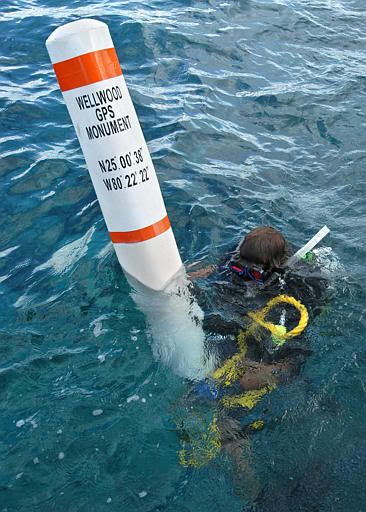
Will Englby, mooring buoy coordinator for the Florida Keys National Marine Sanctuary, positions a buoy above an underwater geodetic marker Thursday, June 17, 2004, in the Sanctuary off Key Largo, Fla. The geodetic marker is the first of its kind under the sea, according to officials, and defines an area of Molasses Reef restored in 2003 following a 1984 ship grounding that pulverized 16,683 square feet of live coral. (AP Photo/Florida Keys News Bureau, Andy Newman)

A Cow-nosed ray is seen in this undated photo. One million baby oysters placed on an artificial reef in the Great Wicomico River were wiped out in a single day by a school of ravenous cow-nosed rays, surprising the federal agency in charge of the restoration project. ``We didn't really know anything about the cow-nosed ray,'' said Doug Martin, project manager for the Army Corps of Engineers in Norfolk, lead agency for the multimillion-dollar oyster initiative. The rays, commonly found in the bay during summer months, tore like a scythe through the $78,000 in baby oysters planted in June in the Great Wicomico. (AP Photo/NOAA via the Roanoke Times, file)

Iin this photo provided by the NOAA Maritime Heritage Program, producer/director John Brooks is seen in this undated photo using high-definition video equipment to document the shipwreck site of the USS Macaw, a submarine rescue ship that sank after striking a submerged reef off Midway Atoll in 1944 during an attempt to rescue the submarine USS Flier. Marine scientists investigating last year's discovery of two sunken ships in the Northwestern Hawaiian Islands came accross two new shipwrecks and a trailof coal that may lead to another wreck. (AP Photo/NOAA Maritime Heritage Program, Robert Schwemmer )
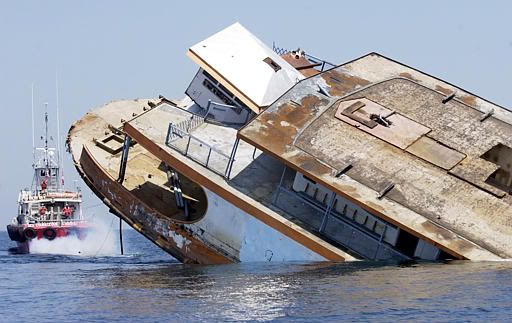
A 194-foot ferry boat is sunk into an artificial reef off Cape May, N.J., Wednesday, Aug. 3, 2005. The ship, which once served as a New York ferry boat and later as a Hooter's Restaurant, is the largest vessel sunk into the reef so far. (AP Photo/Mary Godleski)


The famed Vietnam-era aircraft carrier Oriskany arrives at the Pensacola Naval Air Station, Fla., Wednesday, March 22, 2006. The Navy plans to sink the Oriskany this May as the world's largest intentionally created reef. The Oriskany was first towed to Pensacola in December 2004, only to be towed back to Beaumont, Texas, in June to ride out the 2005 hurricane season. If the Oriskany is sunk according to plan on May 17, it would become the first Navy ship scuttled under a pilot program to reef old warships. (AP Photo/Pensacola News-Journal, Ben Twingley)
|